

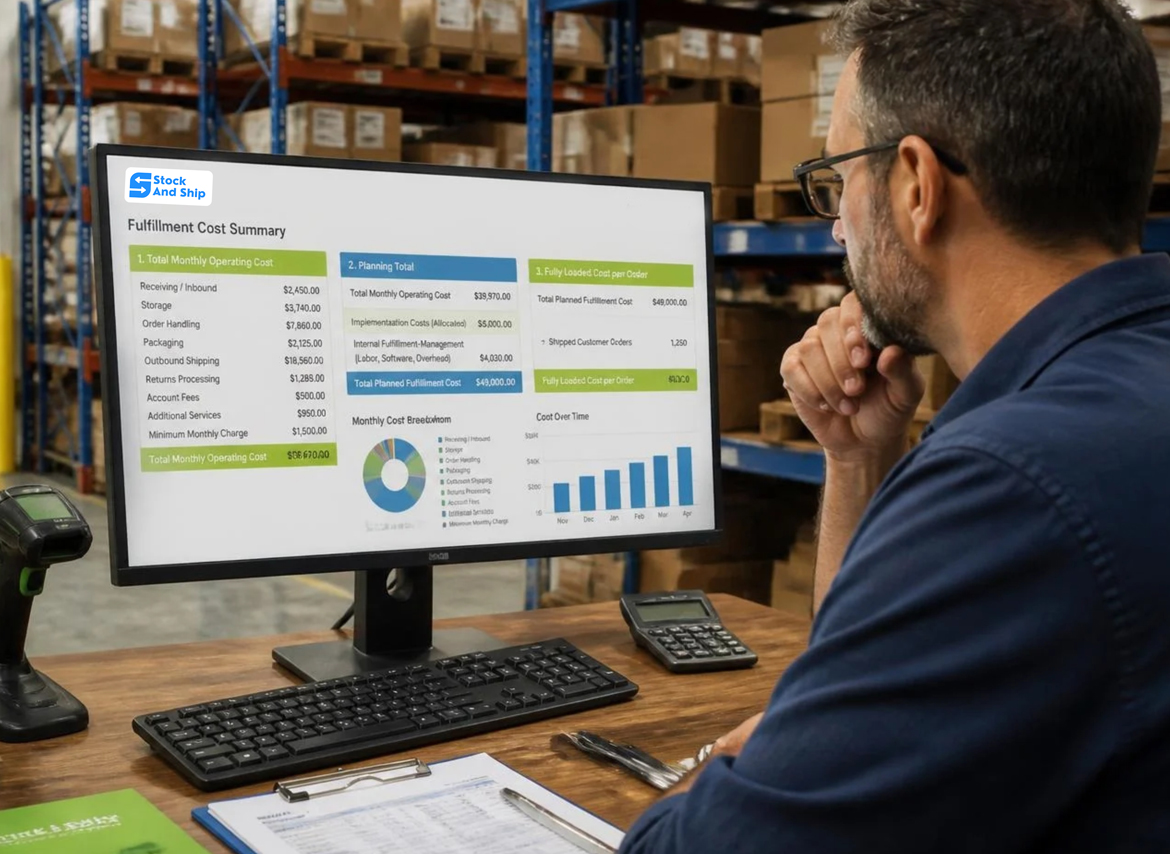
To calculate outsourced eCommerce fulfillment costs, add receiving, storage, order handling, packaging, outbound shipping, returns, account fees, and applicable additional charges. Include any monthly minimum shortfall, then allocate one-time implementation costs across your chosen planning period. Divide the resulting total by shipped orders to estimate your fully loaded cost per order.
The important distinction is between a handling rate and a complete operating cost. An advertised order fee may cover only one part of the process. Your final estimate should reflect your products, order mix, inventory levels, shipping destinations, and contracted services.
This guide explains how to build that estimate, avoid double-counting bundled services, and compare providers using consistent assumptions. All figures in the worked example are hypothetical planning inputs, not Stock & Ship prices or industry averages.
Start With the Total Fulfillment Cost Formula
Build your estimate for a defined period, usually one month. Separate recurring operating charges from one-time transition expenses so you can see both the expected invoice and the broader cost of outsourcing.
Total monthly operating cost = receiving + storage + order handling + packaging + outbound shipping + returns + account fees + applicable additional services + minimum shortfall.
Planning Total = monthly operating cost + allocated implementation cost + retained internal fulfillment-management cost.
Fully loaded cost per order = planning total divided by shipped customer orders.
The first formula helps forecast operating charges. The second supports a broader business comparison. The third translates the result into a figure you can compare with order revenue and product margin.
Define your scope before calculating. If your model includes inbound freight, include it for every provider. If import duties, product purchasing costs, or marketplace commissions sit outside the fulfillment model, keep them separate and label the exclusions. Consistency matters more than making one total appear smaller.
Also distinguish the planning allocation from cash flow. Spreading a setup fee across twelve months may help evaluate long-term economics, but the provider may require the entire payment before operations begin.
Collect the Inputs That Drive Your Costs
The rate card is only useful when you apply it to an operating profile. Begin with the latest order and inventory data and then adjust for expected changes. Select a representative period rather than an unusually quiet month.
- Orders from customers and items shipped monthly.
- Average order unit count Distribution of single item vs. multi-item order.
- Expected packed dimensions, product weight & product dimensions.
- Active SKUs means the unique stock keeping units that require stock tracking.
- Expected pallets, bins, shelves, cubic feet used.
- Frequency of inbound shipments received and whether stock is received by carton, pallet or container.
- Customer location and delivery service requirements.
- Expected return volume and the amount of effort for each return.
- Kitting, Labelling, Inspection, Inserts or Special Packaging Requirements.
Keep orders, units, and shipments separate. An order containing three products may incur one order charge and three unit-handling charges. If that order ships in two parcels, it may also require two labels and two shipping charges.
Build at least a normal-month scenario and a peak-month scenario. Include a lower-volume scenario when monthly minimums could materially affect your cost per order. Apply each provider’s volume tiers to each scenario rather than assuming your busiest-month rate applies throughout the year.
Understand Every Cost Category
Receiving and Inbound Freight
Receiving covers the work involved in accepting inventory into the fulfillment operation. Depending on the agreement, billing may depend on cartons, pallets, containers, units, or labor time. Confirm whether unloading, counting, inspection, and inventory entry are included or separately charged.
Inbound freight is different: it is the transportation cost of moving inventory to the provider. Keep it visible if your calculation aims to capture the complete movement of inventory into and out of the warehouse.
Storage
Match your inventory estimate to the provider’s billing unit. A pallet rate cannot be compared directly with a bin or cubic-foot rate without understanding the space your products require. Ask how partial periods, partially filled locations, and slow-moving stock are treated.
For your forecast, average inventory can be a useful starting point. For the invoice estimate, use the contractual measurement method. A provider billing allocated locations may charge differently from one billing measured occupied volume.
Order and Unit Handling
Identify the base order fee and any separate charge for units or additional picks. Confirm whether the first item is included. Do not add a first-pick charge again when it is already part of a bundled order price.
For a model charging every unit separately, handling cost equals shipped orders multiplied by the order fee, plus shipped units multiplied by the unit fee. A model including several picks requires a different calculation based on the items exceeding that allowance.
Packaging and Labels
Confirm whether standard cartons, mailers, tape, protective materials, and shipping labels are included. Ask separately about branded packaging, inserts, fragile-item protection, and nonstandard cartons. Customer-supplied packaging may also create storage or handling requirements.
A label-printing or label-handling fee is not necessarily postage. Keep those items distinct unless the quote explicitly combines them.
Outbound Shipping
Estimate shipping using actual destination and package data wherever possible. A single assumed shipping price can hide the effect of distant destinations, larger cartons, faster services, or multiple-parcel orders.
Package dimensions matter as well as scale weight. UPS explains that dimensional weight can affect billing and that accurate dimensions help avoid shipping charge corrections. Review its guidance on avoiding shipping charge corrections when checking your package data.
Ask the provider to identify which quoted shipping amounts include applicable surcharges, which can change, and how later carrier adjustments are passed through. Do not assume that an initial estimate is an all-inclusive shipping commitment.
Returns and Additional Services

Separate return transportation from warehouse processing. Then identify whether inspection, repacking, restocking, photography, disposal, or forwarding create additional charges. A return that requires several activities should not be modeled as a single basic receipt unless that is what the agreement covers.
Other services to clarify include kitting, relabeling, inventory counts, special projects, integration support, and account administration. Include only services you expect to use, but record their rates so exceptions do not become invisible costs.
Minimums and Bundled Charges
If a monthly minimum applies, determine which charges count toward it. The shortfall equals the minimum minus eligible charges, but never less than zero. Do not automatically add the full minimum on top of charges that already satisfy it.
Stock & Ship’s published pricing categories illustrate why service-level detail matters: order fulfillment, unit handling, shipping labels, storage, returns, and additional materials appear as distinct items. Confirm the current applicable rates and inclusions in writing before using them in a budget.
Compare Providers on the Same Basis
Give all shortlisted providers the same operational profile. Let each price have the same sample orders, package dimensions, destinations, storage assumptions and return activities. Otherwise, the difference in quoted totals may just be a difference in assumptions, not better pricing.
- Get a full fee schedule and a written list of what it covers.
- Request a sample monthly invoice based on your forecast volumes.
- See what services are bundled up and remove any redundant charges from your model.
- Minimums, tier qualifications, peak-period charges and rate-change provisions.
- Clarify billing for special projects, exceptions, and inventory discrepancies.
- Review rules for termination of contract, removal of inventory and transition.
When comparing outsourcing with an internal operation, include the internal costs that genuinely change: labor, space, equipment, software, packaging, shipping, supervision, and exception handling. Separate avoidable costs from commitments you must continue paying after outsourcing.
For example, an existing lease may remain payable during the transition. It should not disappear from the cash-flow forecast simply because a 3PL takes over order handling. Likewise, owner time is an economic consideration, but it is not automatically a cash saving.
For broader context beyond the calculation, read about how fulfillment centers support eCommerce operations. Use the cost model alongside service requirements rather than treating the lowest estimate as the only selection criterion.
Reduce Costs Without Weakening Service
First, identify the biggest cost-drivers in your own model. If shipping is the most important, consider your packaging size, destination mix and service selection. If you have storage issues, then consider stock levels and replenishment frequency before worrying about a small handling discount.
- Provide accurate product and packed parcel measurements.
- Ascertain whether the packing is too big or too well protected.
- Consistency for SKU records and inbound shipment data .
- Distinguish between routine work and optional preparation and customisation.
- Monitor the reasons for returns and what activities each return involves.
- Match invoices to contracted rates and actual activity.
Evaluate trade-offs before changing the workflow. Smaller replenishments may reduce stock held at the warehouse but increase inbound transportation or receiving activity. Less protective packaging may reduce materials expense but create a different risk profile. The objective is a lower complete cost at an acceptable service level, not the lowest charge on one line.
After launch, compare forecast and actual costs monthly. Investigate whether differences came from rates, order mix, storage, shipping adjustments, returns, or unexpected services. That explanation makes the next forecast more useful.
Frequently Asked Questions (FAQs)
Get clear answers to common questions about calculating outsourced fulfillment costs and comparing provider quotes.
How do you calculate fulfillment cost per order?
Add the fulfillment costs included in your chosen scope, then divide by shipped customer orders for the same period. Label whether the result includes shipping, returns, setup allocations, and retained internal administration so comparisons remain consistent.
Does a pick-and-pack fee include shipping?
Not always. At Stock & Ship, pick-and-pack fees cover picking products from inventory and packing orders for dispatch. Carrier shipping charges are typically billed separately and may be added to your fulfillment costs. The exact pricing depends on your fulfillment plan and service requirements. Review your fulfillment quote to confirm whether shipping is included and understand the total cost per order.
Is Outsourced Fulfilment Always Less Expensive Than In-House Fulfilment?
No. Outsourced fulfilment is not always less expensive than in-house fulfilment. The total cost depends on order volume, product dimensions, storage requirements, shipping destinations, service fees, and transition costs. Compare the full cost of outsourcing with the internal costs you can actually avoid before making a decision.
How should monthly minimums affect a fulfillment estimate?
First determine which charges qualify toward the minimum. Add only the positive difference between that minimum and qualifying charges, unless the contract defines a different arrangement. Model lower-volume months because the shortfall can increase effective cost per order.
Build a Reliable Amazon FBA Preparation Process
A useful fulfillment estimate connects every charge to an operational input: orders, units, parcels, inventory space, returns, or labor. That makes the total explainable and allows you to identify which assumptions most affect your margin.
Build a normal-month forecast, test the conditions that could change it, and ask providers to confirm the same scope in writing. Keep the expected operating bill separate from setup cash flow and broader internal costs so your decision reflects both affordability and long-term economics.
Discuss Your Fulfillment Cost Requirements
Stock & Ship lists marketplace preparation, inventory storage, direct-to-customer fulfillment, and returns-related services. Review the available options, then prepare your monthly order volume, units per order, product dimensions, storage needs, and expected return activities before requesting pricing.
Ask the team to confirm which charges apply to your workflow, what is included, and which services require additional pricing.